 Blog
The Controller Is the Perimeter
Reindustrialization runs on 50 million computers nobody can read.
That is a speed problem and a security problem — the same problem.
Two weeks ago in Munich, I opened the Software Defined Factory conference with a number: China is on track to produce 45 percent of the world's industrial output by 2030. In 2000 it was 6 percent (UN). That is not an accident and it is not a trick. It is decades of focus, capital and execution, and it deserves respect. It also
settles one argument. The West will not out-hire China. In the United States alone, 1.9 million manufacturing roles are projected to stay unfilled by 2033 (Deloitte). Every reshoring plan, every new plant, every defense production ramp lands on the same shop floor and the same night shift. More hands are not coming. The only lever left is how fast each pair of hands can change what a factory does. Not more hands — faster loops of innovation and improvement. We see this happening in IT and AI; now it is time to bring it to the shop floor.
The layer nobody owns
Factories run on industrial controllers — PLCs — at least 50 million of them worldwide by our own conservative count. The architecture dates from 1968. The tooling dates from the 1990s: one proprietary tool per vendor, code that travels on USB sticks and on the one laptop with the right license, no version control on the software that actually moves atoms. Industry — roughly a quarter of global GDP — cannot, in any meaningful sense, be programmed or reconfigured at the speed required.
Physical AI will land on exactly this layer. You cannot deploy intelligence onto compute you cannot address. You cannot train it on code you cannot read. And you cannot secure what you cannot see. The agent standards are arriving fast; every one of them stops at the same door: the controller that runs production. An agent cannot tell you what that device is supposed to be running, who approved the last change, or how to get back.
Why this is a Western problem — and a Western advantage
The defense industrial base is not the plant on the rendering. It is brownfield: shipyards, munitions lines, machining cells, tens of millions of controllers already bolted into factories that cannot stop. Reconstitution speed is decided there, not in slide decks about autonomous factories. The same is true for every allied manufacturer trying to hold its ground against a competitor that adds a new plant every week. We will not win on headcount. We can win on loop time: how fast a change is made, tested, approved and deployed across a fleet — and how fast it is reverted when it is wrong. And a layer this fundamental must not sit in a jurisdiction that can switch it off, and must not become another proprietary tower. It has to be open, and it has to be ours.
The controller is the perimeter
On July 26 and 27, a coordinated attack hit the operational technology of more than 30 community water systems in Minnesota — internet-exposed controllers, changed IP addresses and passwords, operators locked out of their own plants. The detail that matters: at least one organisation found the attack because the logic running on its PLCs did not match what the operators thought was running. Target versus actual. That is the whole discipline in one incident. CISA has been saying for two years that state actors are pre-positioned inside U.S. critical infrastructure. Pre-positioned means: the code on the controller is the battlefield, and most operators cannot read it.
OT security has been sold as a perimeter problem — network segmentation, anomaly detection, another box on the DMZ. Necessary, and not sufficient. If you do not know what code and firmware runs on every controller, you cannot detect a change, you cannot evaluate a vulnerability, and you cannot prove a restore. Security has to live in the layer itself: a complete, versioned record of what runs where; drift detection against the approved state; four-eyes approval before any change reaches a controller, with an audit trail of who, what and when; controller credentials in a vault instead of a spreadsheet; known vulnerabilities mapped to the firmware actually installed, not the firmware the asset list claims. None of this makes anyone compliant by itself. It makes the first question answerable — what is actually running on my controllers tonight — and everything else in OT security starts there.
Performed, not claimed
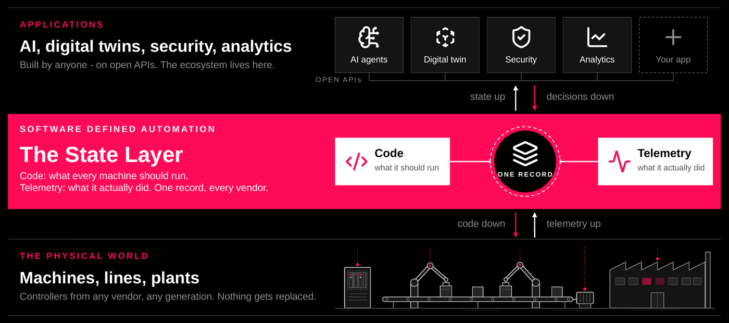
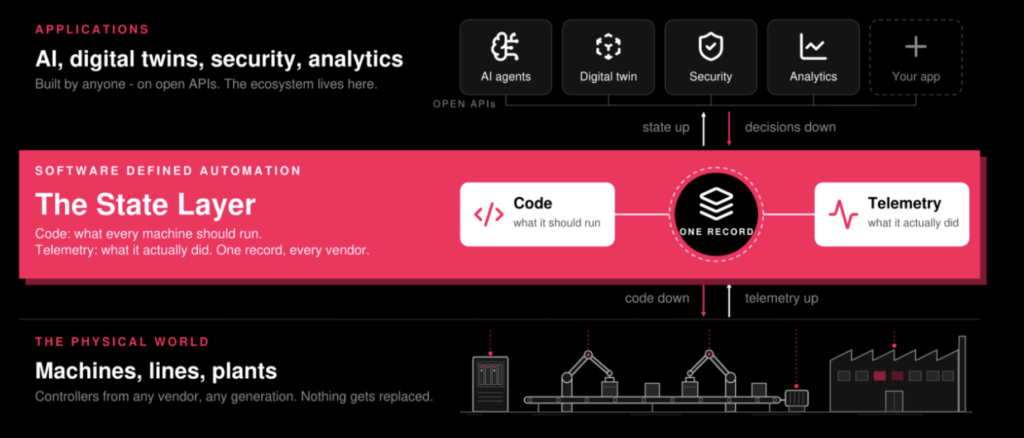
That layer exists. Software Defined Automation makes controllers addressable like cloud compute and extracts their code from proprietary vendor binaries into one normalized system of record — the intended state of the factory, what the atoms should do. On September 29 we added the other half: the State Layer for Physical AI puts the telemetry, what the atoms actually did, next to the version history of what they were supposed to do — to our knowledge for the first time in one layer, across 13 vendor ecosystems, on the brownfield base that already exists. We showed it live on a running SEW-EURODRIVE machine: an AI compared target and actual state, proposed a parameter change, and an engineer approved it before anything moved. AI proposes. The engineer decides. Engineers are at the core of increasingly faster optimizing machines and factories.
I distrust vision decks, so here is the number from our own production platform to remember: in August alone, controllers ran something other than their approved version 4,164 times — changes that were in no version history. That is what the inside of a modern factory looks like when nobody is looking. The operators said the rest on stage in Munich. Henkel found a copied variable name that had hidden in controller code for a year and a half; visible the moment the code was readable, roughly 12,000 dollars per machine. Sanmina cut downtime per incident on a line in Guadalajara from 40 minutes to 5 — a 10x return, in their numbers, not ours. These are not greenfield showcases. They are 30-year-old lines that cannot stop.
The first step is the same for every plant
If you run production — or you are about to, because you are building the next American factory — the first step is the same: find out what is actually running on your controllers. Tonight, not next quarter. Everything else — the faster loop, the AI that proposes, the security that holds — is built on that answer. The factory is code. It always was. The side that can read and change its code fastest wins.
Dr. Josef Waltl is founder and CEO of Software Defined Automation (Boston / Munich). Before SDA he led industrial software at AWS and Azure Industrial IoT at Microsoft, was a product manager for industrial controllers at Siemens and programmed his first PLC at age 16.