[ Automotive ]

Software-Defined Automation for agile automotive manufacturing

Automotive plants rely on complex, highly automated production lines where every minute of downtime impacts launch schedules and margins. Software-defined automation gives OEMs and Tier‑1s the flexibility to adapt lines to new models, options and volumes without months of re-engineering.

[ Benefits ]

Smarter line changes through centralized automation

Software-defined automation enables automotive manufacturers to rapidly reconfigure production lines for new models via centralized PLC versioning and automated deployments, minimizing downtime and launch delays.
  • Zero-trust cybersecurity

    Zero-trust cybersecurity Browser-based engineering which enables secure and maintenance- free IDE access from anywhere.

  • Faster changeovers for new models

    Faster changeovers for new models and variants through centralized PLC versioning and automated deployment.

  • Reduce your IT footprint and immediate cost savings

    Eliminate the burden of managing the IDEs and the laptops/virtual machines they run on. You’ll always work on the most up-to-date, fully patched version of the IDE and OS.

  • Higher OEE and fewer stoppages

    Higher OEE and fewer stoppages with continuous backup, instant code restore and full audit trails. Calculate your ORR hereAI Code Documentation.

  • Standardized automation templates

    Standardized automation templates across plants and suppliers to reduce engineering effort and launch risk.

  • Secure remote access for experts and partners

    Secure remote access for experts and partners without exposing the shop floor network.

Software Defined Automation Customers

[ Customer Reference ]

Software Defined Automation helps Henkel increase productivity and improve collaboration

  • 0%
    Reduction in MTTR
  • 0%
    Backup Compliance
  • 0
    Controllers Managed
  • 0
    Sites Unified
Stefan Müller
Plant Manager, Henkel

“SDA reduced our recovery time from 8 hours to 15 minutes, saving us approximately $2M in the first year alone. We now manage backups for 247 Siemens and Rockwell controllers across 3 sites from a single console. The Git integration means our automation engineers can use familiar tools.”

Read the full story
[ The factory is code. Are you ready? ]

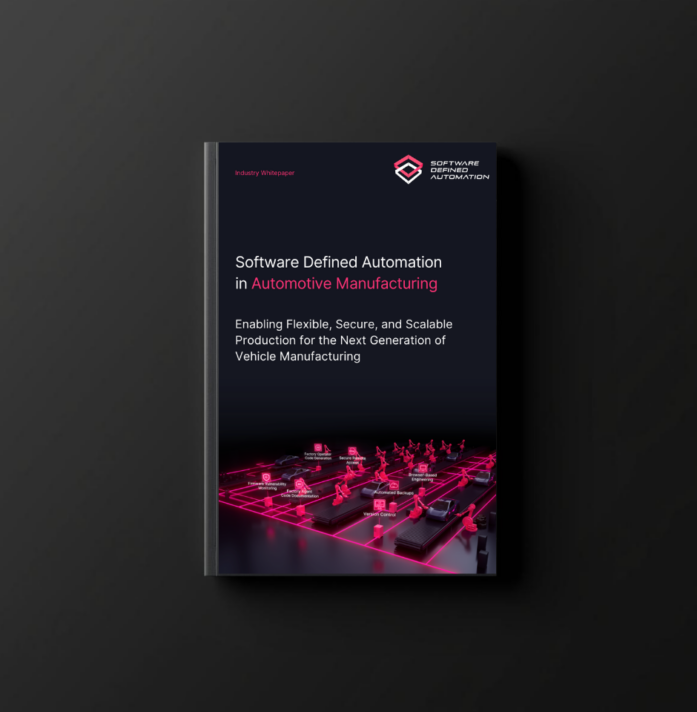
Software Defined Automation in Automotive Manufacturing

Automotive manufacturing is undergoing a fundamental shift. Software-defined vehicles, shorter model cycles, and increasing production complexity are demanding a new approach to factory automation — one that is flexible, secure, and scalable across your entire plant network.

Our latest industry whitepaper, Software Defined Automation in Automotive Manufacturing, explores how a software-driven orchestration layer can help automotive manufacturers standardize operations, improve visibility, accelerate engineering changes, and reduce unplanned downtime — without replacing existing production assets.

What You Will Learn

  • Why traditional automation is reaching its limits:Legacy architectures were built for stable product lines. Today’s automotive plants operate in heterogeneous environments with mixed PLCs, diverse robot brands, fragmented data flows, and growing cybersecurity requirements. The old model can no longer keep pace.
  • How Software Defined Automation addresses the core challenges:  From centralized asset management and automated version control to secure remote access and OT vulnerability management — discover how a unified, vendor-neutral layer transforms the way plants operate.
  • The measurable business case: Reduced engineering effort, faster issue resolution, lower downtime exposure, stronger governance, and a proven foundation for AI-driven optimization and digital transformation.
  • A practical implementation roadmap: A step-by-step approach designed for brownfield environments — pragmatic, incremental, and built around real-world automotive production realities.

Download the Whitepaper

Gain the insights your team needs to modernize automation, strengthen resilience, and stay competitive in an increasingly software-defined industry.